My Cart: 0 item(s)

Extreme Corals News and Updates
Reef Tank Chemical Filtration Guide: Carbon, GFO, Resins and Media Tips
Learn how chemical filtration works in reef aquariums, including activated carbon, GFO, phosphate removers, resins, when to use each media, common mistakes, and how to maintain cleaner water for healthier corals
Learn reef tank chemical filtration with tips on activated carbon, GFO, phosphate removers, resins, water clarity, nutrient control, toxins, and coral health.
by Scott Shiles • April 28, 2026
Reef Tank Maintenance, Reef Tank Equipment
Chemical filtration is one of the most useful tools for keeping reef tank water clean, clear, and stable. A reef aquarium is a closed system, which means dissolved organics, coral toxins, yellowing compounds, phosphate, heavy metals, and other unwanted substances can build up over time if they are not removed through water changes, skimming, biological filtration, and the right filter media.
Good chemical filtration does not replace proper reef husbandry, but it can make a major difference when used correctly. Activated carbon can help polish water and remove dissolved organics. GFO and phosphate removers can help control phosphate. Specialty resins and media can target specific problems. The key is knowing what each media does, when to use it, and how to avoid stripping the water too aggressively.
At Extreme Corals, we see reef tanks do best when filtration is balanced rather than overcomplicated. Corals need clean water, but they also need stability and measurable nutrients. This guide explains the main types of chemical filtration to use in reef tanks, how they work, where to place them, common mistakes to avoid, and how to choose the right media for a healthier reef aquarium.
What Is Chemical Filtration in a Reef Tank?
Chemical filtration is the use of filter media to remove dissolved impurities from aquarium water. Unlike mechanical filtration, which physically traps visible particles, chemical filtration targets substances dissolved in the water that may not be easy to see.
Chemical filtration can help remove or reduce:
- Dissolved organic compounds
- Yellowing compounds that reduce water clarity
- Odors
- Some toxins released by corals or other organisms
- Phosphate
- Some heavy metals and contaminants
- Medication residue after treatment, when appropriate
In a reef tank, chemical filtration is usually used alongside mechanical filtration, biological filtration, protein skimming, water changes, and good maintenance. It should be viewed as part of the overall water-quality system, not a cure-all for poor husbandry.
Why Chemical Filtration Matters for Coral Health
Corals live directly in the water around them, so water quality affects everything from polyp extension and color to growth, feeding response, and long-term survival. When dissolved organics and pollutants build up, corals may become stressed, algae may grow more aggressively, and the tank can become harder to keep stable.
Chemical filtration can help by improving water clarity, reducing unwanted compounds, and supporting a cleaner environment for fish, corals, and invertebrates. Clearer water can also help reef lighting reach corals more effectively, especially in tanks where yellowing compounds have built up over time.
The goal is not to make the water sterile. A healthy reef tank still needs balanced nutrients. The goal is to remove the compounds that create instability, cloudiness, algae pressure, toxin buildup, or stress.
The Main Types of Chemical Filtration Media
There are many chemical filtration products available, but most reef keepers use a few main categories. Each media works differently and should be chosen based on the actual problem you are trying to solve.
The most common chemical filtration media for reef tanks include:
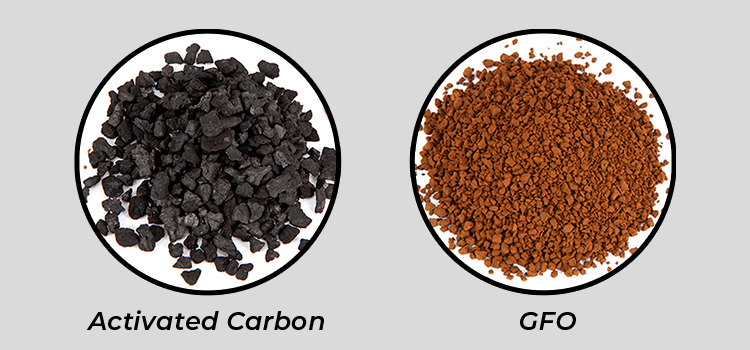
- Activated carbon for dissolved organics, toxins, odor, and water clarity
- GFO for phosphate reduction
- Phosphate-removing resins for targeted phosphate control
- Mixed media blends for broad polishing and nutrient support
- Specialty resins for specific contaminants or polishing needs
- Poly filter pads for broad-spectrum chemical absorption and visual contamination clues
The best media depends on your tank’s water test results, livestock, feeding habits, nutrient levels, and maintenance routine. Adding every type of media at once is rarely the best answer.
Activated Carbon for Reef Tanks
Activated carbon is one of the most widely used chemical filtration media in reef aquariums. It helps remove dissolved organic compounds, yellowing agents, odors, and some toxins from the water. It can make the water look clearer and help reduce the chemical buildup that naturally occurs in a closed aquarium.
Activated carbon is especially useful in reef tanks with soft corals, leather corals, zoanthids, mushrooms, and mixed coral systems where chemical interactions between corals may occur. Many corals release compounds into the water, and carbon can help reduce the buildup of those substances.
Carbon can be used:
- Continuously in small amounts
- Periodically for water polishing
- After coral fragging or heavy coral handling
- After suspected toxin release from soft corals
- After medication use, only when treatment is complete and removal is desired
- When water develops odor or yellow tint
For most reef tanks, carbon works best in a media bag or reactor placed where water can pass through it evenly. Rinse it before use to remove dust, and replace it regularly because exhausted carbon will no longer provide the same benefit.
How to Use Activated Carbon Safely
Activated carbon is helpful, but more is not always better. Using too much carbon too aggressively can clear the water quickly and increase light penetration suddenly, which may stress corals that were used to dimmer conditions. This is especially important in tanks with sensitive LPS corals or corals already under strong lighting.
Good carbon-use habits include:
- Rinse carbon thoroughly before placing it in the system.
- Start with a conservative amount if the tank has not used carbon before.
- Place carbon in moderate to high flow so water moves through it.
- Replace it on a schedule instead of leaving it in the tank indefinitely.
- Avoid tumbling soft carbon aggressively, which can create dust.
- Watch coral response after adding fresh carbon.
If the tank water clears dramatically after fresh carbon, consider reducing light intensity slightly for a short period or replacing carbon more gradually in the future. The goal is steady improvement, not sudden shock.
GFO for Phosphate Control
GFO, or granular ferric oxide, is an iron-based chemical filtration media used to reduce phosphate in reef aquariums. Phosphate is not automatically bad, but too much phosphate can fuel algae growth, reduce coral coloration, and make it harder to maintain a clean reef display.
GFO binds phosphate from the water as water passes through the media. It is commonly used in media reactors, but it can also be used in a media bag in a high-flow area. A reactor is usually more efficient because it allows better contact between the water and the media.
GFO can be useful when:
- Phosphate tests consistently high
- Algae growth is increasing despite good maintenance
- Feeding or fish load is contributing to nutrient buildup
- Water changes alone are not reducing phosphate enough
- A reef tank needs more controlled phosphate export
GFO should be used carefully because phosphate that drops too quickly can stress corals. LPS corals, soft corals, and SPS corals can all react poorly when nutrients are stripped suddenly.
How to Use GFO Without Stripping the Tank
The biggest mistake with GFO is using too much too quickly. Reef keepers sometimes see high phosphate and try to remove it aggressively, but rapid phosphate reduction can cause corals to pale, retract, or decline.
A safer GFO approach includes:
- Test phosphate before using GFO.
- Start with less than the maximum recommended amount.
- Increase slowly only if phosphate remains high.
- Monitor coral color and polyp extension.
- Replace media when phosphate begins rising again.
- Avoid grinding the media into dust in a reactor.
GFO should gently tumble in a reactor, not violently churn. If it grinds itself down, fine particles can irritate the tank. If used in a media bag, place it where flow is strong enough for water contact but not so strong that the media breaks apart.
Phosphate-Removing Resins
Phosphate-removing resins are another option for reducing phosphate in reef tanks. These products typically bind phosphate through chemical adsorption or ion-exchange-style media. Some are designed to work quickly, while others are better suited for maintenance-level control.
Resins can be helpful when a reef keeper wants targeted phosphate reduction without using GFO, or when a particular product fits the filtration setup better. Like GFO, they should be used based on test results rather than guesswork.
The main advantage of phosphate resins is that they can be effective and easy to place in a media bag, reactor, or filter chamber depending on the product. The downside is that they can exhaust quickly in tanks with high phosphate and may need frequent replacement.
Mixed Chemical Media Blends
Mixed media blends combine different filtration materials into one product. Some blends include carbon, phosphate remover, organic scavengers, or specialty resins. These can be convenient for hobbyists who want broad water polishing without managing multiple separate media types.
Mixed media can work well, but it has a limitation: each ingredient may exhaust at a different speed. Carbon may become spent before phosphate media, or phosphate media may exhaust while other components still work. For that reason, advanced reef keepers often prefer separate media when they want more control.
Mixed media blends can be useful for:
- Beginner systems needing simple water polishing
- All-in-one tanks with limited media space
- Temporary cleanup after cloudy water or odor
- Low to moderate nutrient systems needing light support
If your tank has a specific issue, such as high phosphate, targeted media may be better than a broad blend.
Poly Filter Pads and Specialty Absorbers
Poly filter pads and specialty absorbers can be useful for removing a range of dissolved contaminants. Some pads change color based on what they absorb, which can give hobbyists clues about possible metals or other unwanted compounds in the system.
These products are especially useful when something unusual may have entered the tank, such as contamination from equipment, rusting magnets, accidental chemical exposure, or unknown water-quality problems.
Specialty absorbers should not replace regular testing and maintenance, but they can be helpful problem-solving tools. In tanks with unexplained coral stress, they may provide an extra layer of protection while the root cause is investigated.
When Should You Use Chemical Filtration?
Chemical filtration can be used continuously or temporarily, depending on the tank’s needs. Some reef keepers run a small amount of carbon all the time. Others use carbon only occasionally. GFO and phosphate removers are usually best used when phosphate levels or algae pressure show a real need.
Chemical filtration may be helpful when:
- Water has a yellow tint or odor
- Corals appear irritated after soft coral contact or chemical warfare
- Phosphate is consistently elevated
- Algae growth is increasing
- A contaminant is suspected
- The tank has a high fish load or heavy feeding routine
- Water clarity is declining despite regular maintenance
Chemical filtration should be guided by observation and testing. Adding media without knowing the problem can create new issues, especially if nutrients are removed too quickly.
Where to Place Chemical Filtration Media
Chemical media works best when water moves through it, not just around it. Placement matters because media sitting in a dead spot will not contact enough water to be effective.
Good placement options include:
- A media reactor
- A media basket in an all-in-one aquarium
- A filter bag in a high-flow sump area
- A canister filter compartment when maintained properly
- A dedicated chamber after mechanical filtration
Many reef keepers place chemical media after mechanical filtration so large debris is removed before water reaches the media. This helps prevent the chemical media from clogging with particles and becoming less effective.
Chemical Filtration vs Mechanical and Biological Filtration
Chemical filtration is only one part of reef tank filtration. Mechanical filtration removes visible waste and particles. Biological filtration supports bacteria that process ammonia and nitrite. Chemical filtration removes dissolved substances that other filtration methods may not remove efficiently.
A healthy reef tank usually uses all three:
- Mechanical filtration: Filter socks, filter floss, roller mats, sponges, and physical debris removal
- Biological filtration: Live rock, bio media, sand, and beneficial bacteria
- Chemical filtration: Carbon, GFO, resins, phosphate removers, and specialty media
For a broader explanation, read our guide on the three main types of reef tank filtration. Understanding how all three types work together makes chemical filtration much easier to use correctly.
Common Chemical Filtration Mistakes
Chemical filtration is helpful, but it can cause problems when used too aggressively or without testing. Reef tanks thrive on stability, and sudden changes can be harder on corals than the original issue.
Avoid these common mistakes:
- Using too much media at once: This can strip nutrients or change water clarity too quickly.
- Not rinsing media: Dust from carbon or GFO can irritate corals and cloud water.
- Leaving exhausted media in too long: Old media stops working and may collect debris.
- Using phosphate remover without testing: Removing phosphate blindly can stress corals.
- Replacing all media at once: Large sudden changes can affect water chemistry and coral response.
- Using chemical filtration to cover overfeeding: Nutrient control should start with feeding habits and maintenance.
- Ignoring flow through the media: Poor contact makes the media less effective.
Chemical filtration should make the reef more stable, not create constant swings. Use it with a clear purpose and adjust based on the tank’s response.
Chemical Filtration for Coral-Dominant Tanks
Coral-dominant tanks often benefit from thoughtful chemical filtration because corals can release mucus, dissolved organics, and defensive compounds into the water. This is especially true in mixed reefs where soft corals, LPS corals, SPS corals, zoanthids, and mushrooms share limited space.
Activated carbon can be particularly useful in mixed reefs because it helps reduce dissolved organics and some coral-produced compounds. However, aggressive nutrient removal can be risky in coral systems that depend on measurable nitrate and phosphate for color and tissue health.
A reef with pale corals, low nutrients, and weak polyp extension may not need more chemical filtration. It may need more stable nutrients and less aggressive media use. A reef with yellow water, odor, algae pressure, and rising phosphate may benefit from more targeted chemical media.
How to Build a Balanced Chemical Filtration Routine
A strong chemical filtration routine starts with testing and observation. You do not need to run every media all the time. Instead, match the media to the problem.
A practical routine may look like this:
- Use a small amount of activated carbon for water clarity and dissolved organics.
- Test phosphate regularly before using GFO or phosphate resin.
- Use phosphate remover only when phosphate is actually elevated.
- Replace media on a consistent schedule.
- Watch coral color, polyp extension, and algae growth.
- Adjust feeding and maintenance before relying only on media.
- Use specialty absorbers when contamination is suspected.
The best reef tanks are not maintained by media alone. They are maintained through consistent feeding, testing, water changes, equipment cleaning, and careful livestock choices.
Related Corals You May Also Like
Chemical filtration supports healthier water quality for many types of reef corals. If you are building or improving a reef tank, these coral groups and reef guides can help you choose livestock and maintain better stability:
- New Arrival Corals - Browse recently added WYSIWYG corals for your reef aquarium.
- Large Polyp Stony Corals - Explore colorful LPS corals that benefit from stable water quality and balanced nutrients.
- Soft Corals - View hardy soft corals that can thrive in stable reef systems.
- How to Maintain Your Saltwater Aquarium - Learn routine maintenance habits that support cleaner reef water.
- Reef Tank Water Parameters - Review the chemistry levels that support healthier corals.
- Feeding Different Types of Corals - Understand how feeding affects nutrients and filtration needs.
Shop Corals for a Healthy Reef Tank
Good filtration helps create the stable foundation that corals need, but coral selection still matters. Choosing healthy corals that match your lighting, flow, nutrient level, and experience level is one of the best ways to build a more successful reef aquarium.
Browse new arrival corals, LPS corals, soft corals, and Scott's Handpicked Corals at ExtremeCorals.com to find corals that fit your reef system and long-term goals.
Frequently Asked Questions About Reef Tank Chemical Filtration
What is chemical filtration in a reef tank?
Chemical filtration uses filter media such as activated carbon, GFO, phosphate removers, resins, and specialty absorbers to remove dissolved impurities from reef tank water.
Do reef tanks need chemical filtration?
Many reef tanks benefit from chemical filtration, but the type and amount depend on the system. Activated carbon can help with clarity and dissolved organics, while GFO or phosphate removers are best used when phosphate is elevated.
What does activated carbon remove in a reef tank?
Activated carbon helps remove dissolved organics, yellowing compounds, odors, and some toxins. It can improve water clarity and may help reduce chemical buildup in mixed reef aquariums.
What does GFO do in a reef tank?
GFO is used to reduce phosphate. It can help control algae pressure and support better water quality, but it should be used carefully because dropping phosphate too quickly can stress corals.
Can chemical filtration remove too much from reef water?
Yes. Too much chemical filtration can strip nutrients too aggressively or change water clarity too quickly. Corals need stability and measurable nutrients, so media should be used based on testing and observation.
Where should I place chemical filtration media?
Chemical filtration media should be placed where water flows through it evenly, such as a media reactor, media basket, filter bag in a high-flow sump area, or dedicated filter chamber.
How often should chemical filtration media be replaced?
Replacement depends on the media type, tank size, nutrient load, and manufacturer recommendations. Carbon is usually replaced regularly for clarity and organics, while GFO or phosphate removers should be changed when phosphate begins rising again.
About the Author
Scott Shiles is the owner of ExtremeCorals.com, which he has operated for over 25 years and is recognized as one of the early dedicated live coral websites on the internet. A lifelong reef keeper since 1984, Scott has decades of hands-on experience maintaining marine aquariums and previously owned and operated a brick and mortar aquarium retail store for 10 years, including five years alongside Extreme Corals. He holds a degree in Marine Biology and has personally selected and sold hundreds of thousands of live corals. An avid scuba diver who has explored reef systems around the world, Scott shares practical coral care and husbandry knowledge based on real world reef experience.
overall rating:
my rating:
log in to rate
Please log in to leave a comment.
For more information visit: additional resources